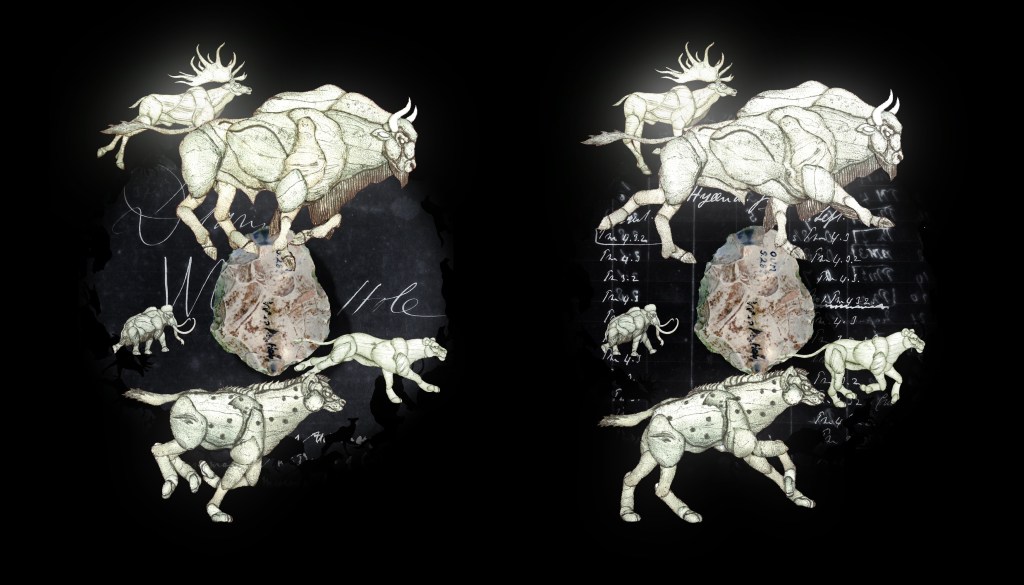
Pages from William Boyd Dawkins journal from the excavation of the Hyaena Den, Wookey Hole and replica hand axe (Wells and Mendip Museum). Paper cut-out giant deer, steppe bison, mammoth, cave lion and hyaena by Sean Harris
In 1857, a thrusting young man with extraordinary energy went up to Jesus College, Oxford. His name was William Boyd Dawkins, the son of a vicar, and it was during his time at the university that the Great Question surrounding what was referred to as the ‘Antiquity of Man’ was answered. To determine this, as the sciences of archaeology, geology and palaeontology became more distinct as disciplines, it had become increasingly acknowledged that rigorous methods must be adopted in order to avoid the doubt that had been cast upon MacEnery’s discoveries.
Accordingly, when a new and undisturbed cave was found at Windmill Hill, near Brixham in Devon, a Committee was formed; of eminent men including Hugh Falconer, Charles Lyell (the author of Principles of Geology), Richard Owen (who devised the word ‘dinosaur’) and William Pengelly of Torquay. Using a method devised by Pengelly, the cave was carefully excavated – and stone tools found beneath the sealed calcite layer alongside the bones of extinct cold climate creatures. Humans must, therefore, have lived in Devon in ancient times – and at the same time as the woolly beasts.
Whilst this in itself was still not enough to convince the scientific world, when eventually considered alongside other evidence from sites in France, the doubts were finally dispelled and in 1859 it became accepted that humans had been present for much longer than the 6,000 years of Bishop Usher’s reckoning. And that they had, at times, co-existed in a constantly changing environment with exotic creatures who no longer roamed the landscapes of Wales and England. And therefore, finally, that all this had nothing to do with Noah’s Flood.
Also in 1859, Charles Darwin published On the Origin of Species. What an extraordinary and dizzying time this must have been – with news stories constantly breaking that changed all understanding of both the origins of humanity and planet Earth itself. Amidst all these great men of the new sciences, the youthfully vigorous and highly driven William Boyd Dawkins was determined to forge a reputation and thereby become a part of this pantheon himself.
In December of that year he duly began the excavation of the Hyaena Den at Wookey Hole in Somerset. Here, stationing himself at the entrance of the cave he examined buckets of cave earth extracted by the local workers who toiled within. He records the bones of many large mammals in quick scribbles in his notebook; a sharp contrast to the methods employed by Pengelly at Windmill Hill earlier that year. And perhaps to his great satisfaction, he too discovered human artefacts – though whether, given the excavation method, his findings would bear the same intense scrutiny as those of Pengelly is debatable.
Dawkins, like his fellow ‘Cave Hunters’ appears to have been drawn to big beasts; the mammoth, giant deer, woolly rhinoceros, cave lion and hyaena. Given the subject matter of cave paintings and the enduring popularity of modern safari parks, maybe this is true of us all…
We’ve seen already the importance of the written word and the Big Book in establishing Truth. In 1866, Dawkins, in partnership with William Ayshford Sanford, embarked on the assembly of a massive work; The British Pleistocene Mammalia. This beautifully illustrated and comprehensive compendium would, Dawkins intended, be the definitive treatise on all of the discoveries made in the previous decades. It would, perhaps, be his monument – and was an idea conceived whilst Dawkins was still in his twenties
 Homotherium