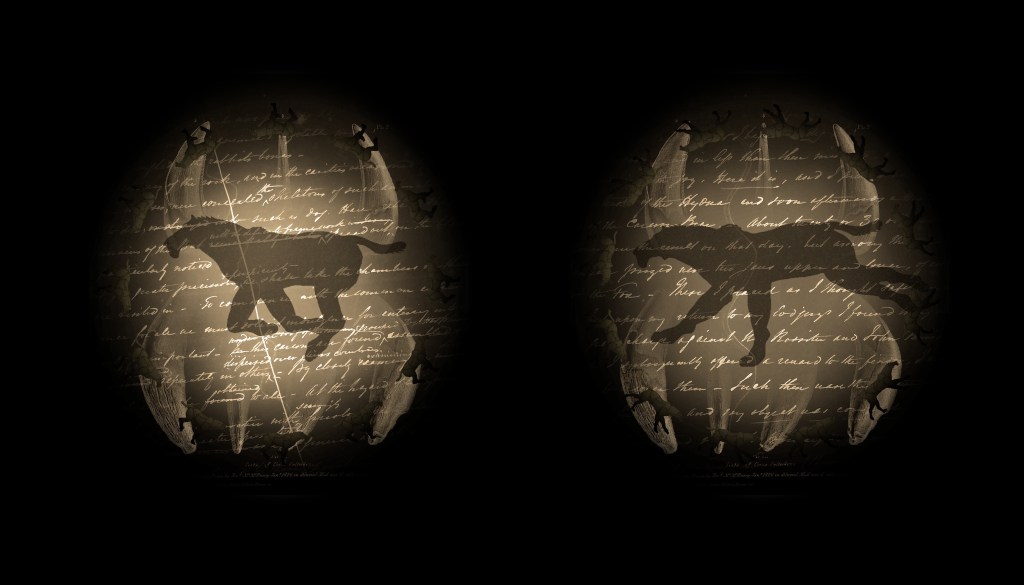
Pages from Father John MacEnery’s script for Cavern Researches and lithograph of Ursus cultridens teeth by Mary Buckland (Torquay Museum). Paper cut-out Homotherium by Sean Harris.
In order to advance his understanding of the great natural forces at play in the world, William Buckland traversed back and forth across England and Wales at great pace. In 1823 he wrote to Lady Mary Cole of the wealthy Talbot family of Penrice Castle, Gower:
Since I left you I found they have discovered two large Tusks of Tygers at Plymouth and passing through Wells I heard tidings of human bones at Wokey (sic) Hole…
Leaving Wells in a chaise with a strange Gentleman he told me of another Cave with Bones near Axbridge, of which I did not have time to stop to make further enquiries as I was nearly buried in snow. I have just got news of more caves at Gibraltar off in Spain…
Scientific disciplines as we would recognise them were now slowly emerging. Amidst this evolution, Buckland, reflecting wider society, maintained his position that the Biblical Flood had occurred – effectively wiping out the great beasts that had once inhabited the British landscape – and that humanity had emerged after the waters had subsided. Thus, elephants, hippopotami, rhinoceroses and their ilk had not co-existed with people.
However, in Devon at Kent’s Hole in Torquay – known today as Kents Cavern – Father John MacEnery was making discoveries that brought this into question. For beneath a hard layer in the cave earth of what is called calcite, amidst the bones of extinct animals, he found flint tools that were indisputably made by people. This indicated that humans and beasts had once shared the West Country landscape, calling Buckland’s conclusion into question.
Buckland, however, was the eminent academic; the Man of Oxford. And so the idea of these implements being made by humans before the Flood was dismissed and, correspondingly, the integrity of MacEnery’s findings and methods called into question.
MacEnery had made other finds of resonance which bring to mind the ‘Tusks of Tygers’ referred to by Buckland in his letter to Lady Mary. Within a part of the cave system he referred to as the Wolf’s Den MacEnery unearthed five spectacular canine teeth and an incisor. These he passed onto Buckland – who was unable to identify them. Eventually they were recognised by Baron Cuvier in Paris as being identical to those of a creature he’d pronounced to be a new species of bear Ursus cultridens that had been discovered in the Val d’Arno, Italy. Reflecting the rapid evolution of the scientific understanding of the time, the ‘bear’, however, was very soon to become a cat…
Taxonomical issues aside, as noted by MacEnery’s fellow West Country cave explorer William Pengelly (more on whom later), other researchers – including the eminent Dr Hugh Falconer – dismissed the possibility of MacEnery having found the teeth in Kent’s Hole. Falconer, a geologist, botanist, palaeoecologist and palaeoanthropologist suggested that MacEnery must have obtained the teeth in Italy and then incorrectly – though ‘in good faith’ – ascribed them to his favourite cavern.
Nevertheless, in the absence of photography which was yet to become available as a means of documenting specimens, a lithograph depicting the teeth was created by Buckland’s rather less well known wife Mary – also a geologist and a scientific illustrator of considerable talent. (Rev. Buckland, appears to have disapproved of women publicly engaging in scientific pursuits so she has largely remained in the shadows…)
This beautiful plate, commissioned by MacEnery at his own expense and ascribing the teeth to Ursus cultridens, was to be included in his own monograph Cavern Researches; the definitive account of his great labour of love at Kent’s Hole. Buckland, however, appears to have sown sufficient seeds of doubt in MacEnery’s mind concerning the evidence he saw before him – and the book would never be published in his lifetime.
For whatever reason, it appears that a cloud was being cast over his work by Establishment figures. In 1829, whilst working in his beloved Kent’s Hole, MacEnery was overcome by foul air and never fully recovered.
Pengelly later observed that MacEnery
‘seems to have been fully aware that his discovery was important and, so far as Britain was concerned, unique… it may be supposed, perhaps, that he anticipated scepticism, and lost no opportunity for furnishing the evidence which it demanded.’
Amidst this rather toxic fug, the only certainty would seem to be that the spectacular teeth from the Wolf’s Den, with their saw-like cutting edges, had cast a spell over these men of the new science…
 Homotherium