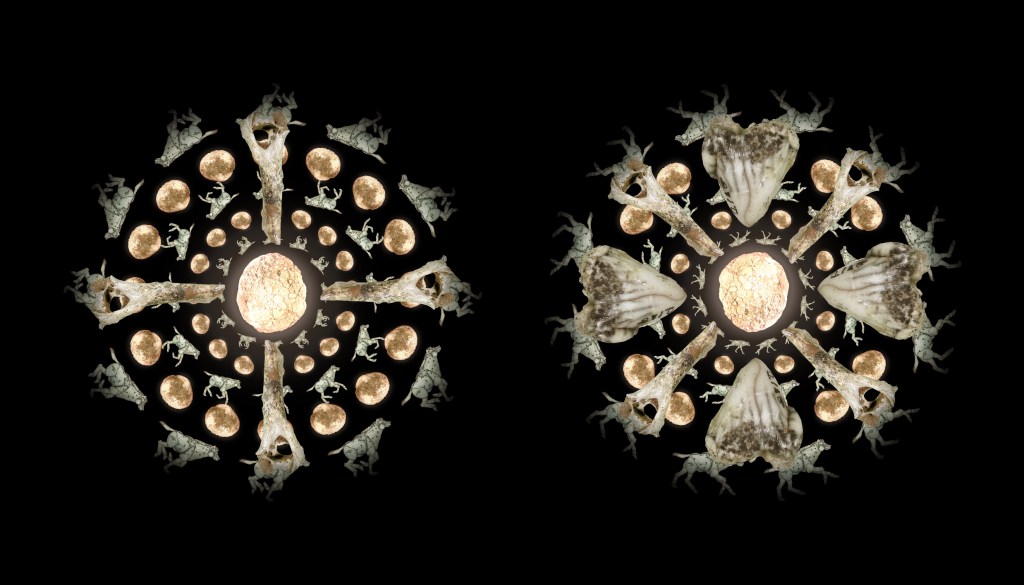
Hyaena long bone (Wells and Mendip Museum). Hyaena coprolite (Torquay Museum), Paper cut-out hyaena by Sean Harris
Fifty years later, ‘the Deluge’ was still seen as the principal agency by which the remains of elephants and rhinoceroses had come to rest in the caves of Wales and England. But, wondered the Rev. Dr. Buckland of Oxford University, HOW were such vast carcasses washed through what were often narrow cave entrances? His explorations of Kirkdale Cave in Yorkshire led him to the answer. Here, the cave floor was carpeted by bones – and many small round white balls. These, he came to realise, were the fossilised dung balls of hyaenas. So the bones had been carried into the cave by hyaenas. Kirkdale Cave was, before the Flood, a hyaena den.
To prove this, Buckland acquired a hyaena and fed it great joints of beef, closely observing its actions at both ends. At the anterior end its incredibly powerful jaws imparted bite marks identical to those on bones he had found at Kirkdale. And at the posterior end, white balls of ‘album graecum’ (ie. poo full of bone) popped out. These he called ‘coprolites’ from the Greek kopros (meaning dung) and lithos (meaning stone).
He published his findings in Reliquae Diluvianae or ‘Relics of the Flood’ in 1823 having concluded that the Deluge hadoccurred as per the Old Testament, that hyaenas, elephants and more had inhabited the Yorkshire landscape prior to its engulfment – and that Humankind had arrived there after the Flood. Thus, a clear separation between beast and the rational mind of man entirely fit for this Age of Reason.
Reliquae Diluvianae is a beautiful book, whose hand typesetting and engraved illustrations carry great gravitas. It is a work of authority; a testament. Yet in wider society there was considerable amusement concerning Buckland’s fixation with the hyaena. But his method of excavating Kirkdale Cave and subsequent findings were nevertheless an important advance – and caused the first cracks in the Flood-story-as-truth to appear.
Buckland had deduced that as he dug further and further down through layers of soil in the ‘cave earth’ he was effectively travelling back through time. And as he did so the idea that the Creation had taken place at nightfall on 22nd October 4004BC, as Bishop Ussher had calculated, seemed increasingly untenable.
This, for a man of The Church, must have been deeply troubling…
 Homotherium