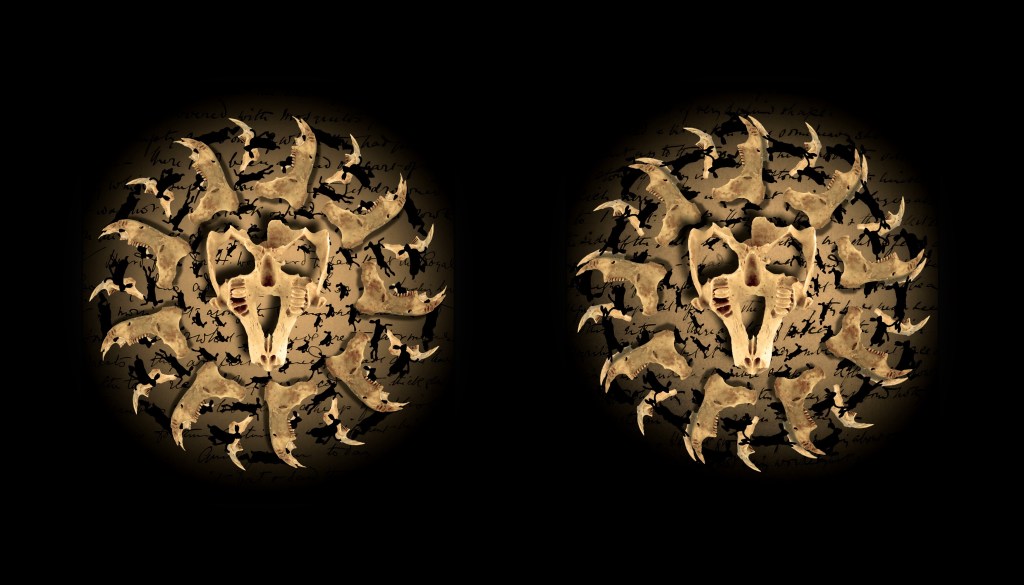
Pages from Dorothea Bate’s Cyprus journal, 1902 (Natural History Museum, London). Pika skull and mandible, lemming mandible (Professor Danielle Schreve, Royal Holloway University London). Paper cut-out mountain hare by Sean Harris
In 1898, four years before William Boyd Dawkins’ final encounter with the Homotherium at Victory Quarry, a young woman presented herself for work in the Bird Room at the Natural History Museum in London. Dorothea Bate was largely self-taught, observing later that her education was ‘only briefly interrupted by school’. At this time women weren’t employed as scientists so Bate was taken on – based on her exceptional skill – as an ‘unofficial scientific worker’, paid by the number of specimens she prepared.
Growing up in the countryside of Carmarthenshire had imbued her with an insatiable passion for exploring her natural surroundings and it was this, combined with her quiet but formidable determination that was to propel her pioneering career as a scientist.
In the same year as Dorothea’s now legendary entrance to the Natural History Museum, the Bate family moved from west Wales to the Wye valley. Now venturing into the border countryside, she explored the limestone caves of the river gorge where, having scrambled up a particularly precipitous scree slope, she eventually reached Merlin’s Cave. Here, in the darkness, she found embedded in the walls the fossil bones of an array of small mammals including lemming and the pika or tailless hare. Now gone from the British landscape but still extant in Northern Europe and Siberia, the presence in caves here of the remains of these cold-climate species yields information no less valuable than the more immediately striking ‘trophy’ remains of megafauna that were so prized by the gentleman Cave Hunters of the nineteenth century.
She was encouraged by her new colleagues at the Natural History Museum to write up her discoveries which were presented in the Geological Magazine as A Short Account of a Bone Cave in the Carboniferous Limestone of the Wye Valley. This was to be the first of many published papers in a distinguished career that continued right up to her death in 1951.
She is remembered with respect and great affection as ‘the spark that would ignite a project’. Perhaps her use of dynamite as a collection tool was more Dawkins than Pengelly – but her selfless demeanour, along with her willingness to cast her research net over creatures small as well as great, sets her apart from the overwhelming majority of her ‘cave hunting’ predecessors. A towering – yet unassuming – figure in twentieth century palaeontology, she contributed much to our understanding of the impacts of climate and environmental change on mammalian species over the millennia.
Undertaking fieldwork not just in Britain but also the Mediterranean and Africa, Dorothea Bate was a significant but quietly rotating cog in what had become a highly complex, inter-connected and globalised science machine.
 Homotherium