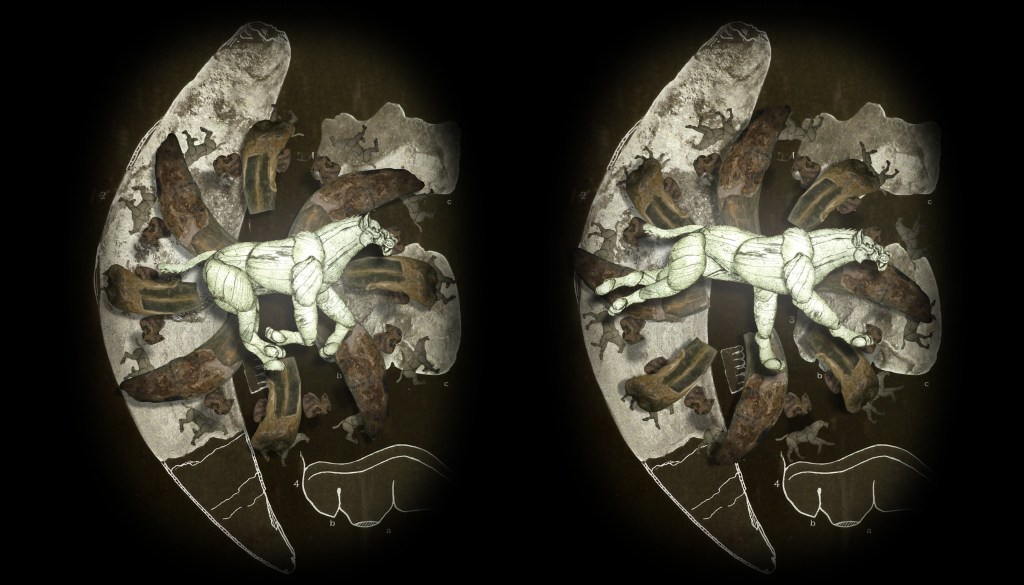
Homotherium teeth from Victory Quarry, Dove Holes and lantern slide (Buxton Museum). Paper cut-out Homotherium by Sean Harris
The controversy of the ‘Creswell Incident’ was – for whatever reason – rooted in Dawkins’ apparent capacity for manipulating the truth in order to achieve his own ends. This single episode has by and large clouded his extraordinary achievements as a palaeontologist and geologist.
By contrast, Pengelly’s measured, analytical and more selfless approach has seen researchers beat a path to Torquay Museum (of which he was a founder) right up to the present day to pore over finds from Kents Cavern. Science demands rigour and precision.
In 1881, shortly after the saga of the Homotherium tooth and his annihilation of Thomas Heath, Dawkins gave up almost all palaeontological and archaeological research. It wasn’t until 1902 that he undertook what would be his final excavation at Victory Quarry, near Doveholes in Derbyshire. Here, a local boy ‘Master Hicks’ had brought some bone fragments to the Buxton antiquary Mr Micah Salt – who drew Dawkins attention to the site. Amongst the fossils were the teeth and leg bones of the scimitar-toothed cat Homotherium crenatidens – the predecessor of the beast found at Kent’s Cavern and Creswell Crags.
It would be easy, in the pursuit of a good story, to cast William Boyd Dawkins as the pantomime villain. But the scope of his work with Pleistocene fossils is staggering and to consign him thus would be to dismiss his strong advocacy for museums as a force for public edification. He mentored J. Wilfred Jackson who left school aged twelve but became a Doctor of Science and curator at Manchester Museum and Herbert Balch, who entered the Post Office to work aged fourteen and eventually founded the Wells and Mendip Museum. Both dedicate monographs to Dawkins – and it is clear that he was a positive force in sparking the passion that drove them both to important endeavours in their respective landscapes. Beyond the museum world he was a fighter for workers rights – especially in the coal mining industry – lobbying hard to get a better education system for miners similar to the ones established in Germany.
Perhaps the man who so relentlessly pursued big beasts had one within – aroused by rivals who sparked in him what seems an irrepressible need to be the Alpha. He was not alone in this. Like stags in autumn these nineteenth century men of science roared, rushed at each other and locked antlers, seeking to gain advantage over their opponents at any cost – including, at times, the truth. And in doing so, they undermined the integrity upon which science – and indeed all society – relies.
But perhaps in the end Dawkins’ inner beast was tamed – by the scimitar-toothed one who, in a new century, drew him back into the field one last time in order to exorcise the demons of past wrongs.
Dare we forgive him?
Can we afford to?
 Homotherium