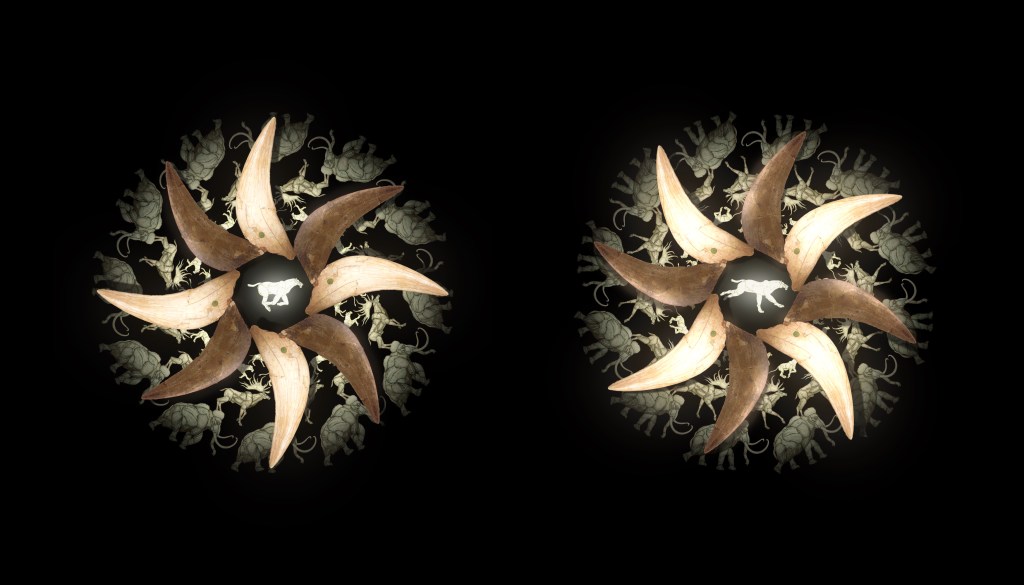
Casts of Homotherium canine teeth (Torquay Museum). Paper cut-out mammoth, giant deer, cave lion and hyaena by Sean Harris
Within the global network of modern science the animal and plant kingdoms are organized into an order in which everything has a name that makes it recognizable wherever you are in the world and whatever language you speak. Within this taxonomy these teeth, with their distinctive and rather chillingly serrated cutting edges, are identified as belonging to an extinct creature called Homotherium latidens. In English, this fearsome beast is known as the Scimitar-Toothed Cat.
Two centuries ago, whilst the Scimitar-Tooth still lurked on the edge of shadows, just beyond the bounds of the emerging scientific order, a footnote on a page within cave explorer Father John MacEnery’s book Cavern Researches described the beast thus:
In this island anterior to the deposition of the drift, there was associated with the great extinct Tiger, Bear and Hyaena of the caves, in the destructive task of controlling the numbers of the richly developed order of the herbivorous Mammalia a feline animal as large as the Tiger, and, to judge by its implements of destruction, of greater ferocity…
In this extinct animal, as in the Machairodus cultridens of the Val d’Arno and the Machairodus megantereon of the Auvergne, the canines curved backwards, in form like a pruning knife having the greater part of the compressed crown provided with a double-cutting edge of the serrated enamel…
Thus, as in the Megalosaurus, each movement of the jaw with a tooth thus formed combined the power of the knife and saw; whilst the apex, in the making of the first incision, acted like the two-edged point of a sabre. The backward curvature of the full grown teeth enabled them to retain, like barbs, the prey whose quivering flesh they penetrated.
An indisputably visceral vision…
But what would we make of these fangs if we were transported even further back in time; beyond the dawning of the age of reason to a world without internet, without a global network of researchers, without reference books and photos? What if we could only imagine what beast these six inch canines might have belonged to? Native Americans, for example, told (and still tell) vivid tales stemming from the dinosaur bones they encountered in the Badlands, weaving them into their seasonal mythologies such that they became timelessly relevant.
What would these teeth mean in a world of stories?
And what would it be like to live in a world where knowledge was shared and passed down through the generations by such stories? Where what was known and true was bound up in myths and legends that were vivid and memorable – but weren’t written down because people chose to remember in non-literary ways.
What would happen to these stories over thousands of years as they were told again and again, passing through many minds?
These are important questions because in some places this is still the way and modern science must find ways to co-exist with something much older, enduring – and very deeply human.
 Homotherium